Limerence, In Bar Language
One case study of limerence: one woman, nine months, far fewer rituals. What got measured, and what it can't tell you.

If you've been typing limerence into a search bar, I understand why. It sounds like a name for the replaying and the checking. A name feels like a handle.
I like the word too. I just wanted to know what's actually behind it, so I read a paper that documents one case of it. One case, one woman. Here's what it holds, in plain words.
No degree, no clipboard. I can't tell you what's happening in your head. I can tell you what got measured.
What It Actually Is
In a case study by Wyant, 2021, in Journal of Patient Experience, people with limerence are described as showing an obsessive attachment to one particular person, the "limerent object," that interferes with daily functioning and with forming and keeping healthy relationships. Wyant is a clinical social worker and psychotherapist. The paper credits the word to psychologist Dorothy Tennov, who coined it in the early 1970s. Wyant writes that uncertainty about the other person's feelings and availability may be what separates it from the early stages of an ordinary romance.
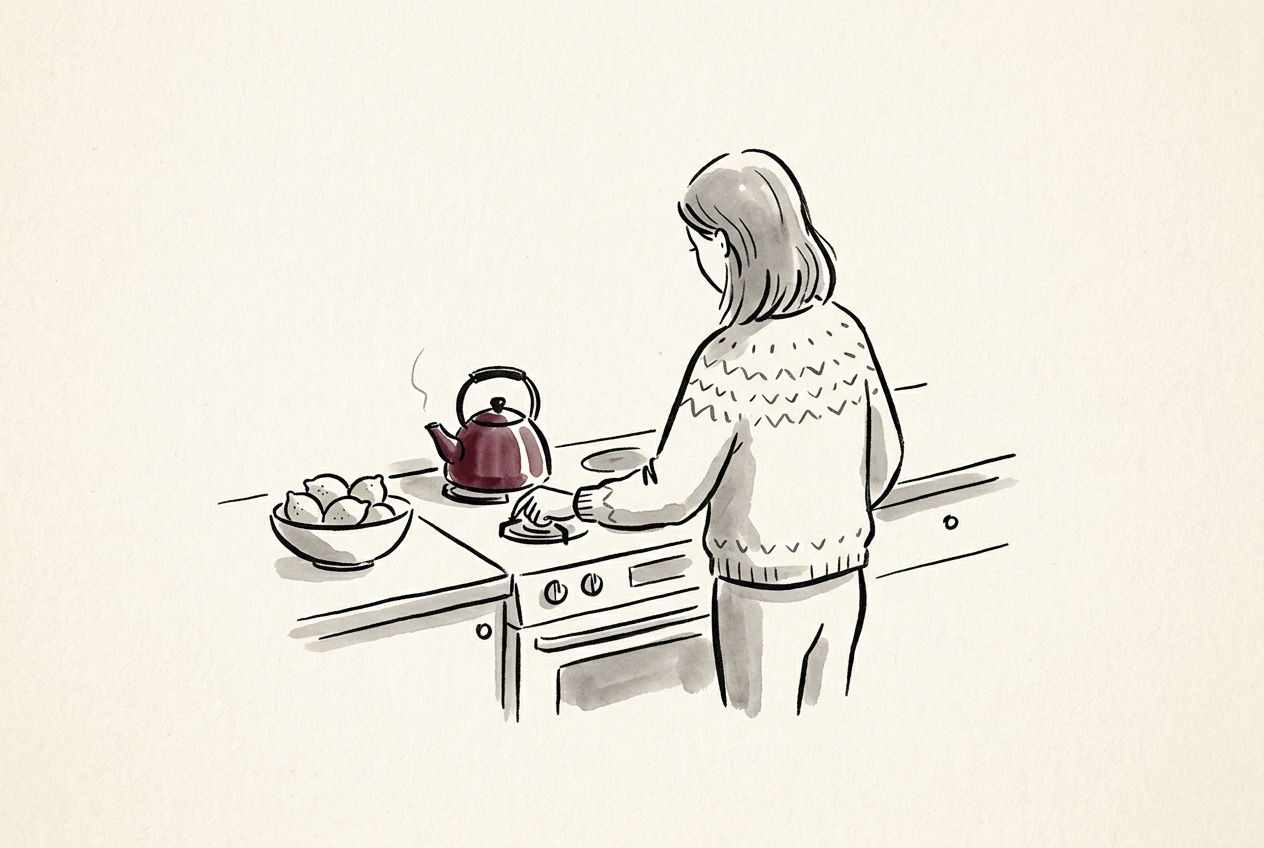
To me it sounds like a kettle left on low: nothing boils over, and nobody ever quite turns it off.
What It Does Not Mean
It does not mean a diagnosis. The paper says plainly that a standard diagnosis of limerence does not exist, because it does not appear in the DSM-V.
At the time of this case, no published screening instruments existed for limerence; the paper notes that a researcher named Wolf has since proposed one and begun work toward validating it. So I'd hold any quiz result loosely.
It also doesn't mean this is about an ex. The woman in the case was 28, and the person she couldn't stop thinking about was a coworker, not a former partner. Everything below is about her. Not about him, and not about you.
What Actually Moves It, And How Much
The patient was the author herself. She saw a licensed clinical social worker starting in March 2016, in 45-minute sessions once every two weeks. The approach combined exposure response prevention, cognitive restructuring and behavioral activation. In practice, she resisted doing her rituals and tracked her slip-ups.
Her rituals included looking at photos of the coworker on social media. One of the balanced statements she wrote for herself was: "I have had many moments of joy and fulfillment that did not involve her." She and her therapist also made a list of activities that offered social connection and other benefits, like physical exercise or a sense of mastery.
She tracked every ritual for two weeks at the start, then tracked for two weeks again nine months later. Time spent on rituals went from about 8 hours to 10 minutes. The count went from 225 to 10.
The size of it
- Who: one woman, 28, who was also the paper's author.
- How long: two weeks of tracking at the start, two weeks again nine months later.
- Compared to what: her own first two weeks. It's a single case, so there's no other group.
- How much: about 8 hours of rituals down to 10 minutes; 225 rituals down to 10.
The paper states its own limits: it's a single case, so you can't assume the results carry over to other people, and everything was self-reported, which leaves room for reporting bias and a possible placebo effect. One person, nine months. That's a hint, not a law.
What You Can't Do About It
You can't make the pull go away on a schedule. Nine months in, she still felt drawn to the coworker and thought of her often, but she could recognize those thoughts and emotions as the product of her limerence. The paper says she also struggled to give up various safety behaviors throughout.
To me that's the kindest line in the paper. Feeling it and following it are two different things.
I'm grateful for what it taught me, I wish him well, and his well-being isn't mine to carry anymore. My days are full of other things now: the studio, the four people I work with, the blue walls.

If you'd like some structure for the first thirty nights, I wrote something for that. The 30-Day No Contact Journal is free. It starts with a few quick questions, then gives you a short talk each night for thirty nights, and the journal answers back.
Not For
This page is not a diagnosis, and it isn't a prescription. It's one case study, read by a woman with no degree. If the checking is eating whole days, every day and not just today, that's a conversation with a person, not a blog post. If you are afraid of him, this page isn't for you. In the US, the National Domestic Violence Hotline is 1-800-799-7233.
If tonight is worse than a bad night: in the US, call or text 988. It is free and it is not an overreaction.
One Thing, Tonight
Don't fight it tonight. Just notice it. The first thing the woman in the case did was track her rituals for two weeks, before she tried to change any of them.
My smaller version is my own suggestion. The paper didn't test it. Write one line for the moment the urge shows up: when I reach for his profile, I will set the phone down and make one mark on paper instead.
One sentence: when this happens, I will do that. It stays in this browser and is sent nowhere. You can stop at any time.
Sound off? Check the side switch.
Gollwitzer & Sheeran, 2006, Advances in Experimental Social Psychology · 94 studies pooled · d ≈ .65 · the same receipt this piece already carries.
Kept. This stays in your browser. Nothing is sent anywhere.
Sources
- Journal of patient experience · Wyant BE · “Treatment of Limerence Using a Cognitive Behavioral Approach: A Case Study” · November 2021 · PubMed
The main note, if you want the whole map: Anxious in love, named: the five things we keep doing →
Keep reading

Anxious in love, named: the five things we keep doing
Rereading his texts, checking who saw your story, asking one more time, guessing, drafting. Each one named, the size of what got measured, and one small thing to do instead.

I Tried To Think My Way Out
I believed that if I ran the argument one more time it would finally resolve. Here is what that cost, and the small thing that changed it.
Longer Out Than In
The breathing thing, except the version that was actually tested — including the part where the people it beat were meditating, not doing nothing.