The 3 A.M. File
Five things I do when I wake at three and my brain has already picked the worst memory it owns, in order, and honest about how little any of them do.
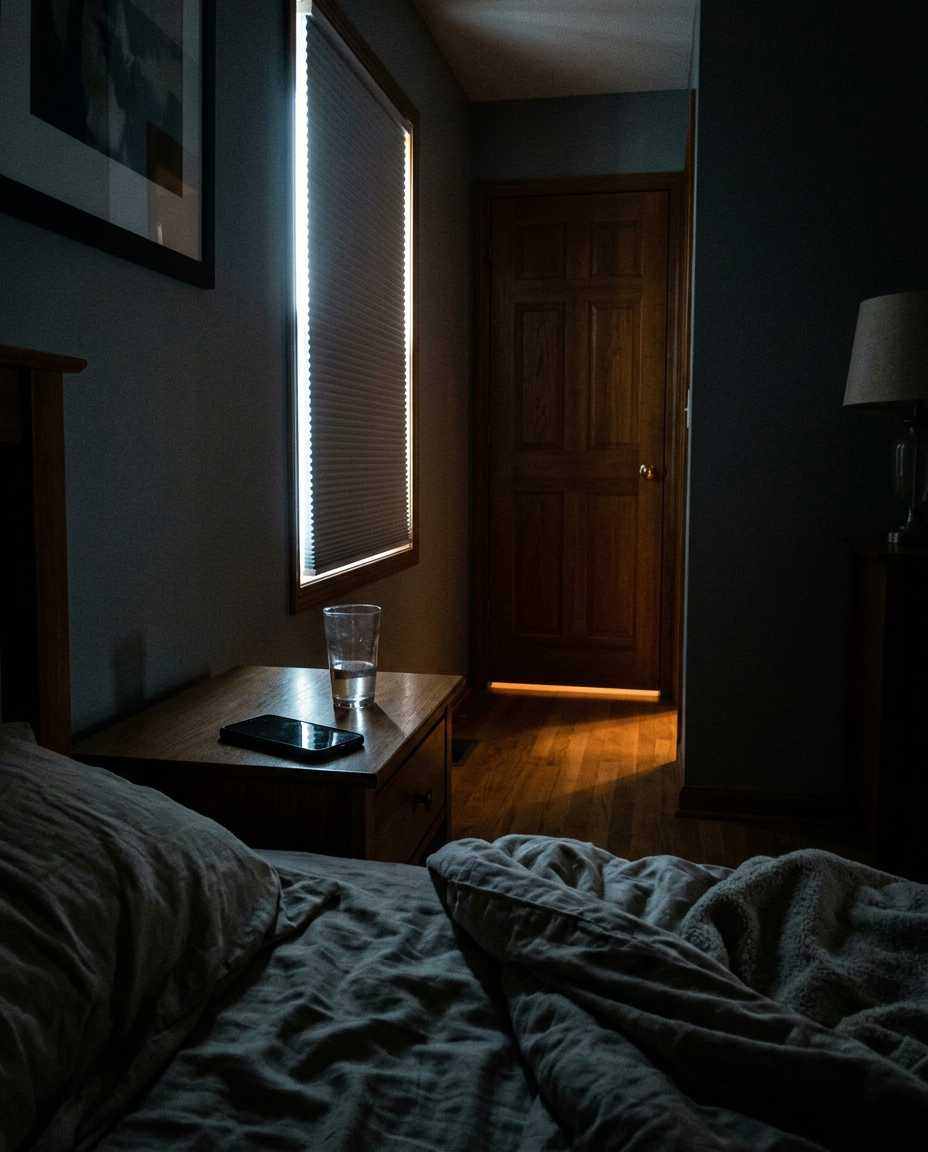
3:14
It is 3:14 in the morning and you did not wake up for a reason. No noise, no dream you can name. You surfaced the way a cork does, and your eyes were open before you agreed to it.
You reached for the phone, because everybody does. 3:14. Four hours until it is socially acceptable to be a person. And in the time it took to read those four numbers, your brain went into the drawer and pulled out the worst thing it owns. Something from nine years ago, in high definition, with the exact sentence you said and the exact face of the person who heard it.
This file is for that. Not for the night you cannot fall asleep at all — different night, different shape. This is the one where you wake in the middle and your own head takes you hostage until the light comes.
Straight with you before you scroll: nothing in here puts you back to sleep in ten minutes. I went looking and it does not exist. What is here is a list of ways to not make the next four hours worse.
First, two things, not one
Two separate things happen at three in the morning, and almost everything written about this mashes them into one. The mash is why you think you are broken.
One. The waking up is not the problem. Ohayon, Krystal, Roehrs, Roth and Vitiello interviewed 8,937 adults across Texas, New York and California (2010, Sleep Medicine, 11, 236 to 241). 35.5% said they woke at least three nights a week. Of those, 43% had trouble getting back to sleep — about 15% of everyone asked.
Read that split again, because it is the whole article. More than a third of the people you know wake in the night. Most go back under and never think about it. The waking is ordinary. The not-getting-back-in is the separate thing, and it is the only one this page is about.
There is a dull physical reason it lands at three, too: deep sleep front-loads the night and REM stacks up toward morning in longer runs, so by three you are in the lighter, dreamier part, the part easiest to float out of. That is textbook sleep architecture rather than one paper, so I am not attaching a citation and dressing it up as a discovery.
Two. Three in the morning is not a neutral hour to think in. Yoo, Gujar, Hu, Jolesz and Walker put 26 people in a scanner and showed them increasingly unpleasant pictures (2007, Current Biology, 17, R877). Half had been kept awake about 35 hours. The tired group's amygdala responses were around 60% bigger.
Now the size of it, which nobody quotes. Twenty-six people. Thirty-five hours with no sleep at all, not five hours and a wake-up. Pictures on a screen, not your own memory of your own worst year. It is a hint that a tired brain weighs the bad thing heavier. It is not a measurement of you tonight.
The one sentence out of this section
The thoughts you are having right now were chosen by a tired brain, not an honest one. They do not survive daylight. You can wait them out.
The sequence
Five things, in order. The first takes about two seconds and it is the one that matters most, which is irritating, because it is also the one that sounds least like help.
1. Turn the clock away. Stop doing the math.
You already did the math once. Four hours and change. Do not do it again in ten minutes, and again in twenty.
Tang, Schmidt and Harvey ran an experiment on precisely this (2007, Journal of Behavior Therapy and Experimental Psychiatry, 38, 40 to 55). Sixty people — thirty good sleepers, thirty bad ones — were told either to watch a clock while trying to sleep or not to. The clock-watchers reported more worry beforehand and took longer to get to sleep, good sleepers included.
Then they ran it again on thirty-eight people with insomnia, against a box built to look identical to the clock that showed random digits instead of the time. This is the half nobody quotes, and it is better than the half everybody quotes. The clock group worried more and said the night had taken longer. The wrist monitors disagreed. Both groups fell asleep in about twelve minutes.
The clock did not cost them sleep. It cost them an honest account of the night — they overshot how long they had been awake by twenty-four minutes, the other group by ten.
So I am not going to tell you the clock keeps you awake, because in that experiment it did not. Two more caveats on top: it measured falling asleep at bedtime, not getting back to sleep at three, and nobody has run this on our exact situation.
What the clock does is make the night feel worse than it is. At 3:14, that is reason enough.
Face down, or in a drawer. Not across the room. Across the room turns into a project.
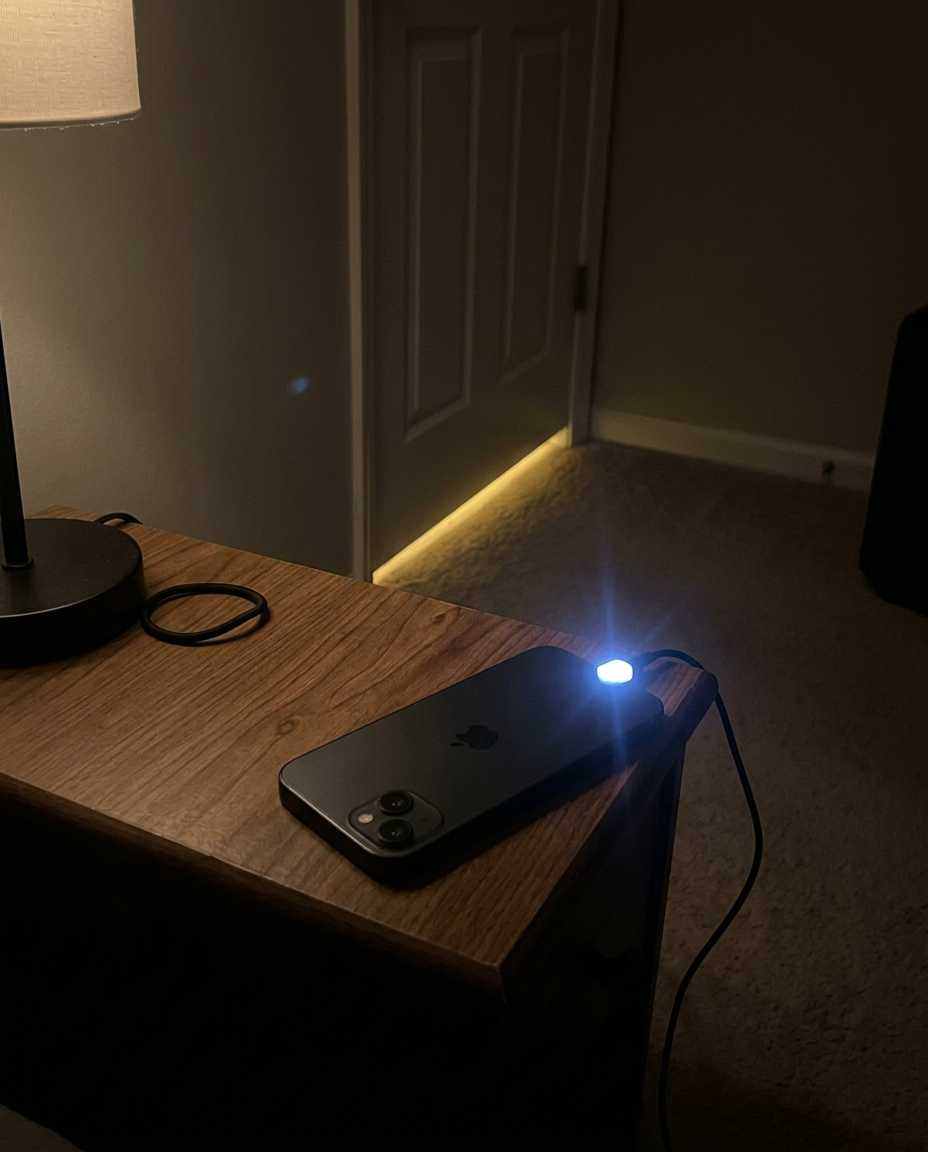
2. Do not turn on the ceiling light.
If you get up, use the lowest light in the house and keep it below your face. Hallway light, phone torch pointed at the floor. Not the overhead.
Gooley and colleagues compared 116 healthy volunteers living under ordinary room light against dim light in a research unit (2011, Journal of Clinical Endocrinology and Metabolism, 96, E463 to E472). Room light shortened the window where melatonin was elevated by roughly 90 minutes, and during sleep hours knocked melatonin down by more than half in 85% of trials.
Here is the part that gets cut off. What they measured was a hormone, not a night's sleep — and it was a retrospective look at people already living in the unit, not a coin flip. Light really does suppress melatonin. That does not automatically mean the bathroom switch at three costs you sleep, because nobody measured the sleep. Using a real mechanism to promise an unmeasured result is the most common trick in this whole subject. Keeping the light low is free and might help. That is the entire claim.
3. Give it about twenty minutes, then get out of the bed.
Not dramatically. Sit in a chair somewhere else, wrap up in something, be a bored woman in a dim room. Go back when you feel heavy rather than when you feel ready.
The twenty-minute rule comes out of stimulus control, one component of CBT-I, the talking-therapy protocol for insomnia. The honest version, which I have never seen in a post about 3 a.m.: what got tested is the whole package over weeks with a trained person, not this one instruction on one night. Trauer and colleagues pooled 20 randomised trials and 1,162 people (2015, Annals of Internal Medicine, 163, 191 to 204). CBT-I cut time awake in the middle of the night by about 26 minutes, and time to fall asleep by about 19.
Twenty-six minutes. Sit with that, because every promise you read tonight will be bigger than what the real thing delivers.
4. Get the thought out of your head and onto paper.
Not journaling. One line, in the dark, on whatever is nearest. Call the bank. She was right and I hate it. Then put the pen down and stop.
I did this for two years and I still do it. It is the thing that broke the loop for me, and the long version is in I Tried To Think My Way Out For Two Years. It worked for me. I'm one person, and one is not a study.
The research is smaller than you would like, and it is not quite research on this. Frattaroli pooled 146 randomised studies of expressive writing (2006, Psychological Bulletin, 132, 823 to 865) and got an average effect of r = .075 — tiny, near the floor of what a pooled analysis can see. Not zero. Tiny.
And what those studies handed people was three to five sessions of fifteen to twenty minutes, writing all the way down into an upsetting thing. Not six words on the back of a receipt in the dark. I am borrowing a number from a different exercise, and you should hold it that loosely.
Both are true at once: in the numbers it is small, and at three in the morning it was not small for me. I am not dropping the inconvenient half.
5. Tomorrow at nine at night, skip the drink.
Not for tonight. It is a candidate for why tonight is happening, and it has more behind it than anything above.
Ebrahim, Shapiro, Williams and Fenwick reviewed 20 studies of alcohol and sleep in healthy volunteers (2013, Alcoholism: Clinical and Experimental Research, 37, 539 to 549). The pattern held across doses: alcohol shortens the time it takes to fall asleep, deepens and consolidates the first half of the night, pushes the first REM period later at every dose tested, then disrupts the second half.
The second half is where you are sitting right now.
Nobody says this on the way to the bar, so I will. The drink that put you under at eleven is a strong suspect for why you are awake at three. I have four years of not testing that personally, which is a fact about me and not evidence about you.
What I'd skip
- Breathing, done as an emergency. Not because breathing does nothing — one version has a real trial behind it, and what it does and does not do is in Longer Out Than In. Skip the emergency. Anything you do at 3 a.m. while checking whether it has worked yet is a task you are now failing.
- Getting up to be productive. Answering email at 3:40 teaches your night that 3:40 is a working hour.
- The sleep score in the morning. A number telling you the night was bad, on a day you have to get through anyway.
- Deciding anything. Not the relationship, not the job, not the message. Write it down at step four and hand it to the 9 a.m. version of you, who is duller and much better at this.
- Working out whether your cortisol is high. You cannot know that and neither can I. That one has its own page.
The size of all this
The disappointing part, out loud, because if I bury it you will find it yourself at 3:14 and stop trusting me.
None of these five steps puts you back to sleep. Steps one to four are damage control: not adding worry, light, effort and decisions to a night already going badly. Step five is prevention, aimed at a different night. The best-supported approach anyone has takes weeks with a trained person and bought 26 minutes. If a blog post could beat that, the blog post would be the treatment.
What this file is for is making the four hours cost less. Some nights that is the whole available win. For a long stretch it was the only one I got.
If you take one thing out of this page: turn the clock away and stop counting. Everything else is optional.
When it's not this
Sometimes waking at three is a symptom of something with a name, and a protocol is the wrong answer:
- It is every night for weeks, not just tonight.
- You wake gasping or choking, or someone has told you that you stop breathing.
- You wake soaked, or pain is what wakes you.
- You wake early, stay awake, and mornings are the worst part of the day, for weeks.
- You started or changed a medication and the nights changed with it.
Those are conversations with a person who can examine you. I can't, and I'd be the wrong one to try.
Not for
This is for a bad night. It is not for a diagnosis, and I'm not the person for that one. No degree, no clipboard. I climbed out and took notes, and the notes are what is on this page.
If you're on something that works, keep taking it. Nothing on this page replaces it, and I'd be the last person to tell you otherwise.
If tonight is worse than a bad night: in the US, call or text 988. It is free and it is not an overreaction.
Tonight
Turn the clock away from the bed before you get into it. Not at 3:14, when it is hard and you are already losing — now, while it is easy and you do not care.
That is the whole thing you do today.
More from Wilder Brain
I Tried To Think My Way Out For Two Years
I believed that if I ran the argument one more time it would finally resolve. Two years of that. Here is what it cost, and the small stupid thing that broke the loop.
Longer Out Than In
The breathing thing, except the version that was actually tested — including the part where the people it beat were meditating, not doing nothing.
Task Aversiveness, In Bar Language
The real predictor of procrastination has a clinical name and nothing to do with being lazy. Here is the number behind the word, and the one thing that actually moves it.